What changed
- From September 21, current full-time, regular-status court employees with at least five years of continuous service can take a one-time $35,000 payment to resign. Approved employees must leave by December 24, and their positions will be eliminated, not refilled.
- The court puts its shortfall at $233.7 million against the funding the Judicial Council calculates it needs — 76.77% of that need, the lowest level since 2021.
- The court itself warns of longer waits at service windows, slower call-center responses and delays in processing legal documents.
What the court announced
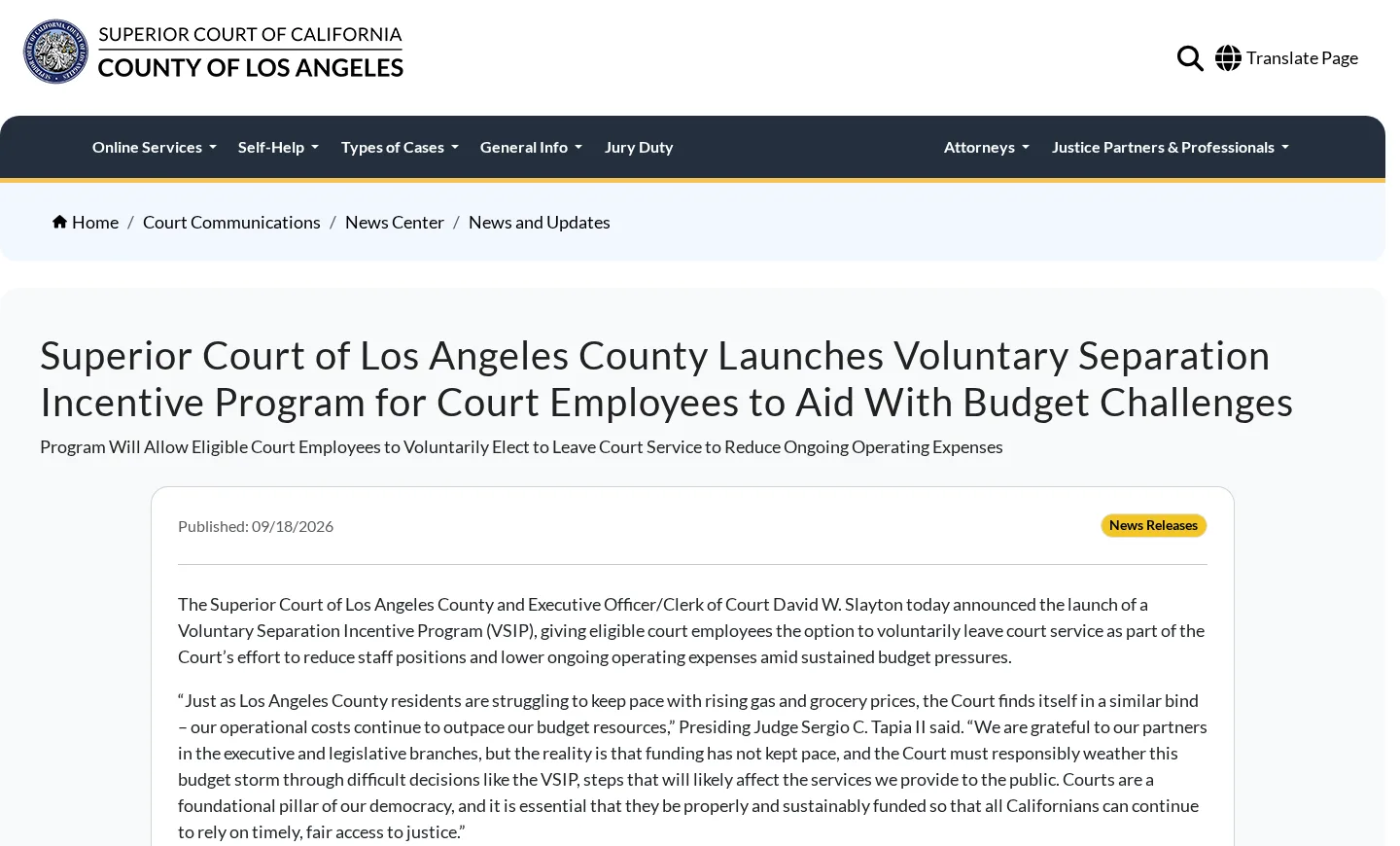
On September 18, the Superior Court of Los Angeles County and its Executive Officer/Clerk of Court, David W. Slayton, launched a Voluntary Separation Incentive Program. The court, which describes itself as the largest trial court in the nation, serves almost 10 million people through 36 courthouses. Starting September 21, current full-time, regular-status employees with five or more years of continuous service can choose to resign in exchange for a one-time payment of $35,000.
Employees who are approved must leave on or before December 24 and cannot be rehired by the court for one year. Every position vacated this way will be eliminated. The court says the goal is ongoing savings rather than one-time relief, and that it wants to avoid layoffs and furloughs in the 2026-27 fiscal year. It ran a similar program in 2024, which it says produced about $4 million in ongoing budget reductions.
The numbers behind it
The court is funded mainly by the state. Measured against the funding the Judicial Council of California calculates it needs to handle the 1.3 million filings it receives each year, the court says it is $233.7 million short. That puts it at 76.77% of calculated need: the lowest level since 2021 and, in raw dollars, the largest gap since at least 2013. The court says the missing money would pay for roughly 1,900 staff.
Part of the gap is inflation. This year's state budget gave the court some inflation funding, but the court projects that rising costs — vendors, county-provided services, custodial expenses and negotiated salary increases — will outrun it by about $9.1 million this fiscal year. Since 2020-21, the court says, inflation funding has fallen 13.1% short of the state Department of Finance's own estimate of what was needed, roughly $88 million in total.
What slower service can mean for you
The court has not said which courthouses or services will be affected first, or when. What it has said is specific: longer wait times at service windows, slower responses from its call center, and delays in processing legal documents. Presiding Judge Sergio C. Tapia II said the steps "will likely affect the services we provide to the public."
The announcement does not change any filing deadline. If you are working toward one, build in extra time rather than planning to ask a clerk or call the court at the last minute. If you file electronically, state law treats a document the court receives at any time on a court day, up to 11:59:59 p.m., as filed that day — even if the court takes longer to process it afterward. A document received on a day the court is closed counts as filed on the next court day.
In civil cases at the LA court, other than small claims and complex cases, attorneys must e-file under Local Rule 3.4, and people representing themselves may choose to. Probate follows the same approach: e-filing is required for attorneys and optional for self-represented parties. Before you go to a courthouse in person, check the court's website for current hours and instructions.
What we don't know yet
The court has not said how many employees it expects to take the offer, or how deep the service effects will run. The court says it is also streamlining administrative work, delaying or dropping some special projects and reviewing programs outside its core mission, and that it is looking at every reasonable saving before "more severe actions such as layoffs or furloughs." We will update this item when the court announces specific service changes.
Who this affects
- People representing themselves who file papers or ask questions in person or by phone
- Attorneys and legal staff waiting on processed filings, conformed copies or other clerk actions
- Court employees with five or more years of continuous service deciding whether to apply before the December 24 separation deadline
Source & how to verify
Superior Court of Los Angeles County news release, "Superior Court of Los Angeles County Launches Voluntary Separation Incentive Program for Court Employees to Aid With Budget Challenges," September 18, 2026 (LACourt.ca.gov, News Center, News Releases). The e-filing timing rule is California Code of Civil Procedure section 1010.6(e)(3); the court's e-filing requirements are on its eFiling pages.
- Court news release: Voluntary Separation Incentive Program (September 18, 2026)
- California Code of Civil Procedure section 1010.6 (electronic filing)
- LA Superior Court: Civil eFiling
The funding figures are the court's own, measured against the funding the Judicial Council calculates it needs. The court has not yet said which services will be cut first or when, so check its website for current hours and procedures before you go.
Reading note: Published September 21, 2026. This article summarizes public documents as they stood on that date. Court procedures, fees and rules change, so check the official sources above for the current version. LA Law Hub is not a law firm, and this is general information, not legal advice. For questions about your own situation, talk to a lawyer licensed in California.